The picturesque suburban landscape of White Plains, New York, is characterized by its historic architecture, lush tree canopies, and a humid continental climate. While these features define the beauty of Westchester County, they also create an ideal ecological niche for one of the most structurally significant pests in the Northeastern United States: the Black Carpenter Ant (Camponotus pennsylvanicus).
As a premier provider of pest control white plains ny, Westex Pest Management views the suppression of these wood-destroying organisms not merely as a matter of convenience, but as a critical requirement for public health and structural safety. Carpenter ants are responsible for millions of dollars in property damage annually, yet many homeowners attempt to manage infestations using over-the-counter (OTC) remedies. Statistics from the National Pest Management Association (NPMA) suggest that wood-destroying organisms cost U.S. property owners over $5 billion each year.
In White Plains, the failure of do-it-yourself (DIY) methods is rarely due to a lack of effort, but rather a lack of technical understanding regarding the complex biology and social structure of these insects. Here are ten clinical reasons why DIY carpenter ant control frequently fails and why a professional exterminator white plains is necessary to protect your home.
1. Misidentification of the Species
Effective pest management begins with precise taxonomic identification. Homeowners often confuse the Black Carpenter Ant with other species, such as the pharaoh ant or even the wharf borer. Carpenter ants are relatively large, with workers ranging from 6 to 13 millimeters (approximately 1/4 to 1/2 inch) in length, while queens can reach 20 millimeters (nearly 1 inch).
If you misidentify the species, you will likely select the wrong treatment protocol. For instance, treatment strategies for bed bugs or silverfish are entirely irrelevant to the wood-excavating behavior of Camponotus. Professional technicians are trained to identify specific physiological markers, such as the evenly rounded thorax and the single node on the pedicel, ensuring the treatment matches the biology.
2. The "Contact Kill" Fallacy
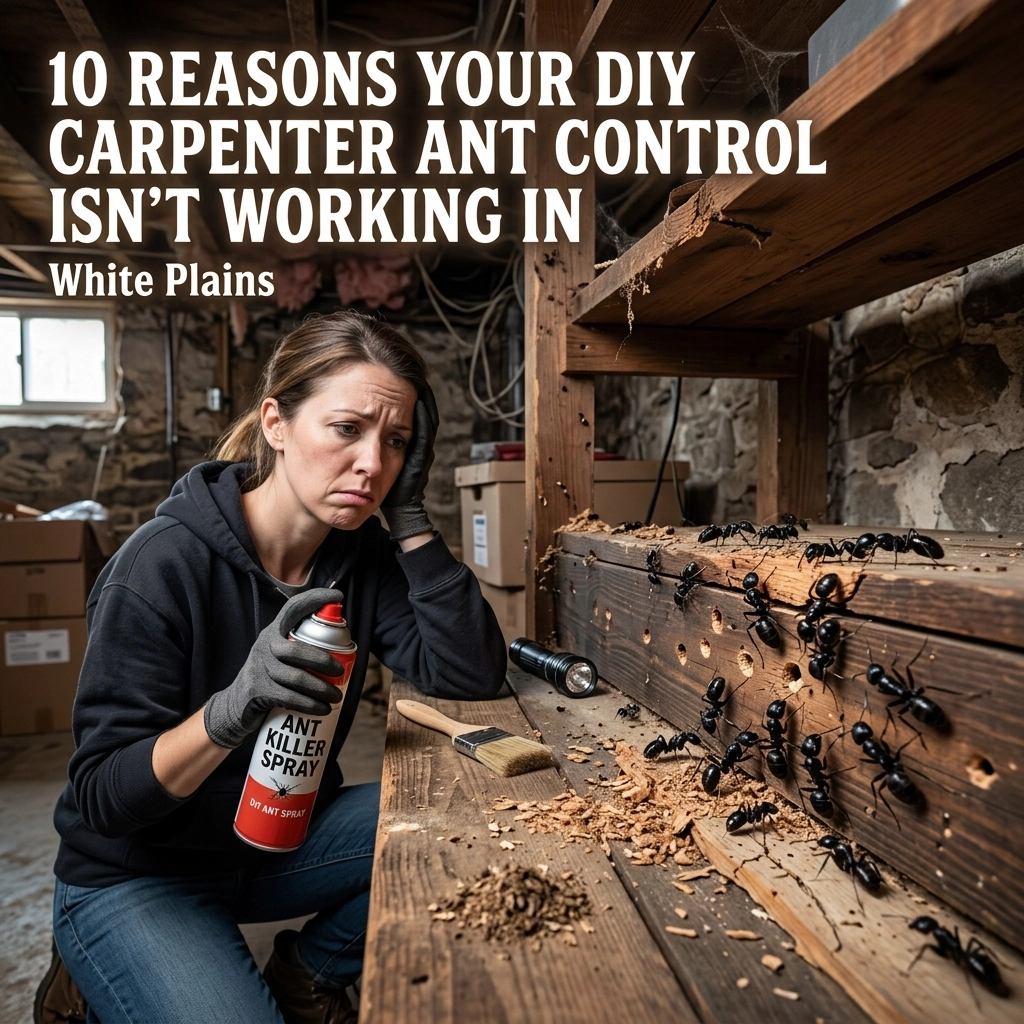
The most common DIY approach involves purchasing a pressurized aerosol spray from a local hardware store. When a homeowner sees a line of ants in the kitchen, they spray the visible insects. While this provides immediate gratification by killing the foragers on contact, it does nothing to address the colony.
Carpenter ants utilize a sophisticated social structure. The ants you see represent only about 10% to 15% of the total population. By killing the foragers instantly, you are merely "pruning" the colony. Furthermore, many OTC sprays contain pyrethroids which act as repellents. This can cause the colony to sense a threat and relocate deeper into the wall voids, a biological response known as "budding," which effectively spreads the infestation to other areas of the home.

3. Failure to Locate the Parent Colony
One of the most complex aspects of carpenter ant biology is their use of satellite colonies. In the White Plains environment, the "parent" colony: which houses the queen, eggs, and early-stage larvae: is often located outdoors in a high-moisture environment, such as a decaying oak stump or a stack of firewood.
The ants found inside your home are often part of a "satellite" colony. Satellite colonies contain workers, pupae, and mature larvae but do not require the same high humidity levels as the parent nest. DIY treatments almost exclusively focus on the interior satellite nest. Unless the parent colony is located and neutralized, the interior of the home will continue to be re-infested as the queen produces new workers to replace those killed by DIY efforts.
4. Overlooking Structural Moisture Dynamics
Carpenter ants do not consume wood; they excavate it to create galleries for nesting. They are biologically attracted to wood with a moisture content of over 20%. In Westchester County, aging infrastructure and seasonal fluctuations often lead to "micro-leaks" in roofing, flashing, and window sills.
DIY efforts often focus on chemicals while ignoring the environmental conditions. A professional exterminator white plains uses specialized tools, such as moisture meters and thermal imaging cameras, to identify high-moisture zones within the building envelope. Without addressing the underlying moisture issue, the home remains a high-risk site for future colonization by carpenter ants and other moisture-loving pests like earwigs.
5. Inadequate "Frass" Analysis
Carpenter ants are meticulous cleaners. As they tunnel through structural timbers, they push out debris known as "frass." To the untrained eye, frass looks like simple sawdust. However, a clinical examination of frass reveals a mixture of wood shavings, fragments of soil, and the exuviae (disposed exoskeletons) of dead ants.
Homeowners often vacuum up this debris without realizing it is the primary diagnostic indicator of an active gallery. Professionals analyze the location and composition of frass to triangulate the exact position of a nest within a wall void, allowing for targeted, low-impact injections rather than broad-spectrum spraying.
6. Poor Bait Formulation and Palatability
Baiting is a science that requires an understanding of the colony's nutritional requirements, which shift seasonally. In the spring, carpenter ants typically seek proteins to support the growth of new larvae. By mid-summer, their preference often shifts toward carbohydrates (sugars) to provide energy for the workers.
Retail baits often sit on store shelves for months, leading to the degradation of the active ingredients or the hardening of the attractant. If the bait is not palatable or if it contains the wrong nutritional profile for the season, the ants will simply ignore it. Professional-grade baits are formulated with advanced pheromone attractants and slow-acting non-repellent chemicals that ensure the toxin is shared throughout the entire colony via a process called trophallaxis (communal feeding).

7. Neglecting the "Canopy Bridge"
White Plains is known for its beautiful, mature trees. However, these trees often serve as a direct highway for carpenter ants. Branches that touch the roofline or siding provide a bridge that bypasses any "perimeter" chemical barrier a homeowner might apply to the foundation.
DIY treatments rarely account for these aerial entry points. Professional protocols involve a holistic "Integrated Pest Management" (IPM) approach that includes recommendations for vegetation management: specifically, maintaining a 12-inch clearance between foliage and the structure: to disrupt the ants' foraging trails.
8. The Complexity of "Trenching" and Foundation Barriers
Many homeowners attempt to create a "moat" of pesticide around their foundation. However, improper application can lead to environmental contamination and the development of pesticide resistance. Furthermore, if the product is not applied at the correct concentration or depth, the ants will simply find a gap: sometimes as small as 1.5 millimeters: to gain entry.
Professional pest control white plains ny utilizes specialized equipment to apply termiticides and ant-specific liquids that bind to the soil, creating a long-lasting, non-detectable zone. Because the ants cannot detect these professional-grade materials, they walk through them and unknowingly carry the active ingredient back to the nest.
9. Lack of Acoustic and Thermal Monitoring
Carpenter ants are most active between the hours of 10:00 PM and 2:00 AM. In the silence of the night, a large infestation can sometimes be heard; it sounds like a faint "crinkling" or rustling within the walls. This is the sound of thousands of ants moving and communicating through "stridulation" (vibrating their bodies against the gallery walls).
DIYers lack the acoustic sensors and borescope cameras required to verify the success of a treatment. A professional service doesn't just "spray and pray"; we use diagnostic technology to confirm that the activity within the wall has ceased, ensuring the structural integrity of your home is preserved.
10. Underestimating the Risk of Secondary Pests
A failed DIY carpenter ant treatment often leaves behind weakened wood and dead insect organic matter. This can attract secondary "scavenger" pests. An unresolved moisture and wood issue can lead to infestations of ladybugs looking for overwintering sites, or even attract american cockroaches and house flies to the decaying organic material.
Furthermore, neglected carpenter ant galleries are frequently utilized by flying squirrels or mice as entry points into the attic. By failing to solve the ant problem professionally, you may inadvertently be inviting a wider range of public health threats into your living space.

The Necessity of Professional Intervention
The structural safety of your home is a huge responsibility. While DIY methods may offer a temporary reduction in visible ant activity, they rarely achieve total colony elimination. At Westex Pest Management, we view our role as a vital component of local public health and hygiene. We provide a guaranteed, science-based approach to pest suppression that protects both your family and your single largest investment: your home.
If you suspect a carpenter ant infestation in White Plains, do not wait for structural sagging or visible wood damage to occur. Contact us today for a comprehensive inspection and a professional-grade solution that works. You can also explore our current coupons for savings on our essential protection plans.
Protecting White Plains from the "enormous task" of wood-destroying organism management is what we do best. Let the experts at Westex Pest Management handle the science, so you can enjoy the peace of mind you deserve.